


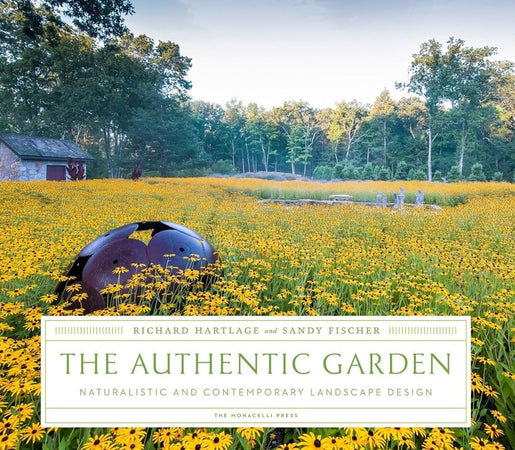



The Authentic Garden: Naturalistic and Contemporary Landscape Design
Sandy Fischer and Richard Hartlage · The Monacelli Press, 2015 · 224 pages
Hartlage and Fischer run Land Morphology [https://www.landmorphology.com/] here in Seattle — the firm behind the planting at Chihuly Garden and Glass. Their argument is one we take to heart: in the best gardens, plants lead the design, not hardscape. The thirty landscapes gathered here are proof that ecology and beauty aren't opposites, and that a garden rooted in its own place will always feel more honest than one imposed on it. A regional book with a national reach, and a touchstone for how we think about planting.

A Pattern Garden: The Essential Elements of Garden Making
Valerie Easton · Timber Press, 2007 · 216 pages
Val Easton wrote the garden column for the Seattle Times' Pacific Northwest Magazine for years, and this book distills a lifetime of looking closely. She identifies fourteen patterns — paths, enclosure, water, the pull of a hidden destination — that separate a garden that's merely tidy from one that answers a real human need for beauty and refuge. It's the rare design book that helps you understand why a space moves you, then hands you the tools to make your own. We think about her fourteen patterns often.

Naturalistic Gardening: Reflecting the Planting Patterns of Nature
Ann Lovejoy, photographs by Allan Mandell · Sasquatch Books, 2002 · 160 pages
Ann Lovejoy gardens on Bainbridge Island, a ferry ride from where we started, and no one writes about Northwest gardening with more warmth or wit. "Gardening is by definition interference with nature," she begins — then spends the book showing how to interfere gracefully, borrowing nature's own sense of flow and sequence rather than fighting it. Allan Mandell's photographs are reason enough to own it. This is naturalism with a Northwest accent, which is to say, our accent.

Dear Friend and Gardener: Letters on Life and Gardening
Beth Chatto and Christopher Lloyd · Aurum Press, 2021 · 304 pages
Two of Britain's greatest gardeners — Chatto, the ecological pioneer of dry and damp gardens; Lloyd, the brilliant contrarian of Great Dixter — were also old friends, and for a year they wrote each other letters about everything: failures and triumphs, weather and lunch, what came up and what didn't. The result is a portrait of the gardening life as it's actually lived, in seasons and friendships rather than projects. We love it for the reminder that a garden is, in the end, a beautiful conversation that goes on for years.

The Story of Gardening
Penelope Hobhouse · Princeton Architectural Press, 2020 · 512 pages
Two of Britain's greatest gardeners — Chatto, the ecological pioneer of dry and damp gardens; Lloyd, the brilliant contrarian of Great Dixter — were also old friends, and for a year they wrote each other letters about everything: failures and triumphs, weather and lunch, what came up and what didn't. The result is a portrait of the gardening life as it's actually lived, in seasons and friendships rather than projects. We love it for the reminder that a garden is, in the end, a beautiful conversation that goes on for years.

The Art of Planting
Rosemary Verey, photographs by Andrew Lawson · Little, Brown, 1990 · 168 pages
Rosemary Verey made the English potager fashionable again and designed gardens for clients from Elton John to the Prince of Wales, but her real gift was for combinations — knowing which plants make good neighbors, and how a border changes chromatically and texturally across the seasons. This one's out of print, so you'll be looking for a used copy, but it's worth the hunt for anyone who wants to plant with a painter's eye.

Time and the Gardener: Writings on a Lifelong Passion
Elisabeth Sheldon · Beacon Press, 2004 · 288 pages
Sheldon wrote these essays as an octogenarian, looking back on three decades in her Finger Lakes garden, and the book carries the particular wisdom of someone who knows that no great gardener is young. The central insight is one we believe completely: time is an ingredient, as real as soil or light. You can't rush a garden into being, and you wouldn't want to. Lyrical, funny, and quietly bracing — a book to grow older alongside.

The English Flower Garden
William Robinson · first published 1883; widely available in reprint editions · 734 pages
The book that started the argument we're still having. Robinson rebelled against the stiff, carpet-bedded Victorian garden and made the case for hardy plants grown naturally, in mixed borders that look at home in the landscape — the direct ancestor of nearly every book on this shelf. More than a century later it reads as both a manifesto and a comfort. When people ask where the natural garden begins, this is the honest answer.

Sunset Western Garden Book
The Editors of Sunset · TI Inc. Books, 9th edition, 2012 · 768 pages
The book every Western gardener owns, or should. For more than eighty years Sunset has been one of the West's most trusted gardening voices, and this is its masterwork — an encyclopedia of plants paired with the climate-zone system that finally took the guesswork out of "will this grow here." Those Sunset zones are the reason a Northwest gardener and a desert gardener can both find honest answers in one volume. We keep it within arm's reach, and it's no accident that our own thinking about zones and what thrives where starts in the same place this book does. The reference that taught the West to garden by where it actually lives.

Gardening with Native Plants of the Pacific Northwest
Arthur R. Kruckeberg and Linda Chalker-Scott · University of Washington Press, 3rd edition, 2019 · 392 pages
Arthur Kruckeberg was a University of Washington botanist and one of the founding voices of the native-plant movement here; this third edition, updated by horticulturist Linda Chalker-Scott with new chapters on garden ecology and the science behind it, carries that legacy forward. What sets it apart is restraint — rather than cataloging every native plant, it selects the ones actually worth a place in your garden, more than 900 of them, each with a photograph and a clear-eyed paragraph. It's the book that makes the case that gardening with what belongs here isn't a sacrifice but a richer way to garden. Our north star on natives.

Trees of Seattle
Arthur Lee Jacobson · 2nd edition, 2006 · 496 pages
There is no book more local than this one. Jacobson walked the city for years and produced a guide to its hundreds of tree varieties that reads like equal parts field manual and love letter — care and planting advice braided together with legend, lore, and the particular history of how a given tree came to stand on a given Seattle street. It's the kind of deep, specific attention to one place that we aspire to in everything we do. If you want to understand the canopy over your own neighborhood, start here.

Cass Turnbull's Guide to Pruning
Cass Turnbull · Sasquatch Books, 3rd edition, 2012 · 384 pages
Cass Turnbull founded Seattle's PlantAmnesty [https://www.plantamnesty.org/] with a mission she summed up as ending "the senseless torture and mutilation of trees and shrubs caused by mal-pruning" — and that wit is exactly why this book works. Covering 160 plants with clear instructions and illustrations, it demystifies the one task that intimidates more gardeners than any other, and does it with the warmth of a teacher who has seen every mistake and forgives them all. A Northwest institution in book form, and the friendliest cure we know for pruning anxiety.